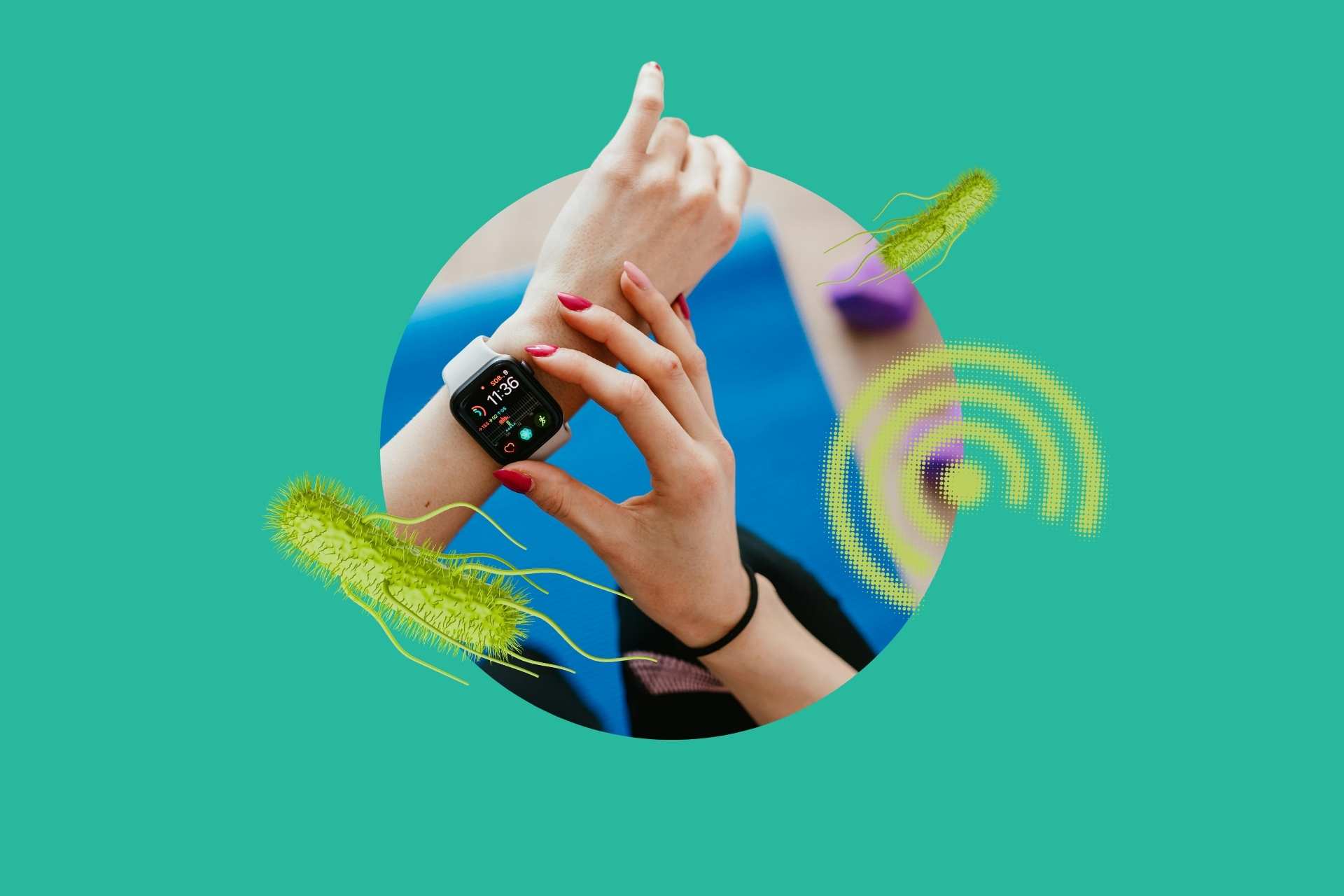
Your smartwatch knows your heart rate. It knows your blood oxygen, your sleep stages, your step count, your stress score. It has become, in barely a decade, an impressively attentive companion. And it is completely blind to the 1.5 trillion microorganisms living on the surface of your body. One must be clear about what this means. It is like building a weather station that cannot detect humidity.
That number is not rhetorical. Byrd and colleagues quantified it in Nature Reviews Microbiology in 2018. Your skin hosts a microbial civilisation that defends against pathogens, regulates local immune responses, and produces metabolites that influence wound healing, inflammation, and, yes, how you smell. When these communities fall out of balance, the consequences range from eczema to chronic wound infection to systemic immune disruption. And until recently, detecting that imbalance required either a laboratory swab or the innovative Sequential adhesive skin patch, followed in both cases by days of waiting. Your €300 smartwatch, meanwhile, with all its sensors and all its processing power, has nothing whatsoever to say about it.
That is about to change. A new generation of biosensor-equipped wristbands is learning to read the chemical language of the skin microbiome in real time. Not by identifying individual bacterial species, which would require genomic sequencing, but by capturing the volatile organic compounds, the pH shifts, and the ion concentrations in sweat that serve as a biochemical fingerprint of microbial activity. Different bacterial populations leave different signatures. Staphylococcus species produce short-chain fatty acids like isovaleric acid. Corynebacterium species contribute thioalcohols. When the balance between these populations shifts, the chemical profile shifts with it, often hours or days before any visible symptom appears on the skin.
The engineering behind this is serious and, I must say, genuinely clever. Electrochemical biosensors using enzyme-modified electrodes can detect specific VOC-related metabolites in sweat, and Gao et al. demonstrated fully integrated sweat-sensing arrays back in 2016 in Nature. More recent prototypes use surface-enhanced Raman spectroscopy adapted for flexible substrates, achieving molecular specificity that electrochemical sensors alone cannot match. A group in Grenoble has been integrating SERS substrates into wristband formats with promising results on detecting bacterial quorum-sensing molecules. ETH Zurich has developed stretchable gold nanomesh electrodes that maintain conductivity when bent or compressed. These are not concept drawings. They are working prototypes.
What makes the latest devices genuinely interesting, however, is not the sensors alone. It is the pairing with on-device machine learning. The wristband does not attempt to tell you which bacteria are on your skin. It captures the chemical profile and classifies it against trained models that distinguish healthy microbial states from dysbiotic ones. The output is not a species list. It is a signal: your skin ecosystem is stable, or it is beginning to drift. That distinction, delivered continuously and in real time, is something medicine has never possessed before.
In France, we say “prévenir vaut mieux que guérir”. To prevent is better than to cure. It is one of those formulations that everyone endorses and almost nobody acts upon, because our entire healthcare economy is constructed around treating damage, not preventing it. Prevention requires seeing a problem before it announces itself. This is precisely what microbial sensing on the wrist makes possible. Dysbiosis on the skin is now implicated in atopic dermatitis, acne, psoriasis, and chronic wound infections. More recent work links skin microbial composition to systemic immune function. If one can detect the drift before the flare, before the infection, before the breakdown, one is not treating disease. One is intercepting it. And that, I would argue, terrifies every business model built on the assumption that the patient will wait until it is too late.
The near-term applications are already evident. Personalised skincare, for one, ceases to be guesswork. The global skincare market is worth over 180 billion dollars and most of it is built on the assumption that one cannot actually measure what a product does to the skin. A wristband that shows you, in real time, how your microbiome responds to a new moisturiser, a dietary change, or a week of poor sleep renders that assumption obsolete. The dermatology industry should be nervous. It will not be, of course, until it is too late.
But the applications that matter most are clinical, and this is where the current state of affairs crosses, in my view, from the disappointing into the negligent. Consider a post-surgical patient whose wristband detects early VOC signatures of wound infection hours before redness or fever appear. A diabetic patient whose band flags the microbial shifts that precede foot ulcers, the leading cause of non-traumatic lower limb amputation worldwide. Elderly residents in care facilities whose bands alert staff to skin breakdown before a pressure ulcer forms. Every one of these complications is currently managed after the damage is done. We wait for the wound to infect, the ulcer to open, the skin to break, and then we spend thousands treating what a fifty-euro sensor could have prevented. The intervention window moves from reactive to pre-emptive. That is not an incremental improvement. It is an indictment of every system still operating without it.
And then there is the horizon that excites me most. Within a decade, the convergence of skin microbiome data with gut microbiome profiling, genomic information, and environmental sensors points toward something we have never had: a continuous, integrated biological dashboard. Not a gadget that counts your steps and gamifies your morning walk. A system that understands your body as an ecosystem and tells you when that ecosystem is shifting, before you feel it, before your doctor sees it, before the symptom has a name. The wearable industry has spent ten years perfecting the art of telling you what already happened to your body yesterday. The next ten years will be about telling you what is about to happen tomorrow.
I am not naïve about the obstacles. The skin microbiome varies enormously between individuals, between body sites, between seasons. Sensor stability under continuous wear is unsolved. Separating meaningful biological signal from environmental noise requires work that is far from finished. And the privacy implications of continuous biological surveillance demand governance frameworks that do not yet exist. These are real problems, not details one waves away in a paragraph.
But the trajectory is set, and the people who should be paying the closest attention are not yet in the room. Hospital administrators still purchasing wound care as a reactive expense line. Insurers modelling chronic skin conditions as inevitable cost centres. Elderly care operators treating pressure ulcers as an occupational hazard rather than a preventable failure. The intelligent wristband is not coming to replace any of them. It is coming to make their current model of care look, within a few years, indefensibly late.
Apple, if you are reading this, perhaps we should talk.
Et voilà.
 Latest related content